About Me

Find out more about me here.
Showing posts with label health. Show all posts

31 August 2017

Hypocrisy Tonight

Tonight, I prepare to be a hypocrite. My Indiana Hoosiers have their season opener on the gridiron, hosting the (2) Ohio State Buckeyes. Even though I have two majors objections to football, I will watch anyway--because I am weak. First, football, as it is currently played under the rules, inarguably causes long-term brain injury. Second, college football disproportionately attracts young men of color with the promise of fame and stardom--a group of people who are structurally thwarted from the conventional means to economic wellbeing--though only a tiny fraction of those who pursue this route will actually become professional. As a sociologist and thinking person, I know these two related facts to be true--and, yet, I will nonetheless watch. I will watch because football is more than just entertainment; it is a connection to something larger than myself, to a group of people scattered by geography and time. Sports generate solidarity for their fans. (Incidentally, sports also generate a great deal of solidarity for the athletes as well. Despite being only a mediocre player, I was on the football team in high school largely because I felt a deep connection to my teammates.) Logic is no match for social forces.

For those of us who know rationally that football needs to change or be abolished, it is not enough to make a call to reason. We also need to offer a cultural substitute, another activity around which fans could rally. Short of that, there will be no change.

In just over a week, I could expand on this post as the NFL season kicks off without Colin Kaepernick. 

06 June 2016

Updated Figures for "Spuriousness: Weight and Health"

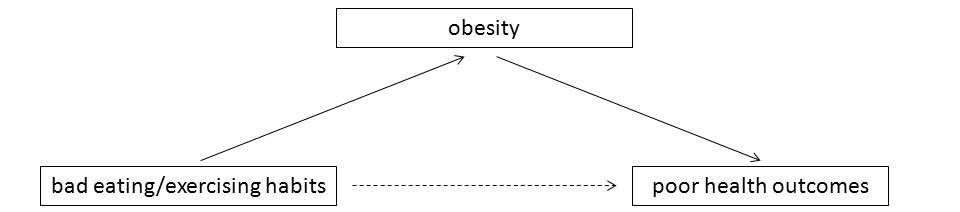
Here are just a couple new figures to better make the point I tried to make in a previous post about the spurious correlation between obesity and poor health:

The Typical Model

The Sociological Model

19 July 2012

19 June 2012

Spuriousness: Weight and Health

Last week, my wife was watching an episode of ABC's The Revolution. I don't know much about the show, but I wanted to comment on the episode I saw. Here is a link. (Sorry, it won't let me embed.) The bulk of the show is about the changes that a woman had made over five months in her physical activity. Most importantly, with the help of professional trainers, she developed an exercise regimen that was sustainable, rewarding, and effective. The climax of the show, however, was a big reveal in which the woman tore through a life-sized poster of her old self, shocking the audience with her much more slight outward appearance. The message was contradictory: it's about healthy living--no, no, it's really about meeting a culturally specific definition of physical attractiveness.

I was reminded of this post from Sociological Images that shows evidence that, while increased body mass can exacerbate their absence, health is really all about behaviors. (The research calls these "habits," healthy eating and exercise for example.)

Medical science, and thus our larger culture, has been making a common causal error, namely spuriousness. Spuriousness is sometimes a difficult concept to understand so here are some concept maps so that we can visualize the relationship. First, here is how we have come to commonly (and incorrectly) understand weight and health. As you can see below, we tend to believe that being obese directly causes poor health outcomes. Eating bad foods (and too much of them) and not exercising may increase our rates of obesity (or so we think), but it is obesity itself that is deleterious to our health.


Now, here is how the data correctly link weight and health. As you can see below, it is actually eating bad foods and not exercising that is directly deleterious to our health. Being obese can compound that effect, but it does not drive the outcome. There most certainly is a strong correlation between obesity and health, but, correlation is not causation! The supposed relationship between obesity and poor health is spurious.


Back to The Revolution. Shows like this--and it is certainly not alone; these ideas are ubiquitous--do us a disservice by reinforcing an agential and spurious worldview. The ironic tagline "It's about you!" leads women to believe that it amounts a personal choice toward self-improvement (read: "willpower"), ignoring the social constraints on the prescribed outcomes (e.g. work/life balance issues). The focus on improving "self"-confidence is blind to the definitions of beauty that we inherit from others that may be literally impossible for most people to attain. And, we erroneously couch all of this in the language of "health," incorrectly legitimizing harmful cultural values in the name of "science."

13 April 2012

Getting One's Hide Tanned on Campus

Student Health Services here on campus is offering very cheap spray-on tanning to students. It's subsidized through student fees, and the health folks are offering it as a UV-free alternative to actual tanning--and just in time as a swanky, new tanning salon has opened downtown. In theory, this is good, right? Faux tans don't increase melanoma rates the way UV tans do. Is it good, though, to perpetuate the valuation of tanned skin (on white people)?

Let me lay out a couple of arguments to put this in perspective. First, many have argued that owning and wearing faux fir is contrary to the animal rights cause against firs because it still maintains that firs--even if fake--are valuable and desirable. It would be better to shift our tastes and behaviors altogether, so goes the argument. Second, there has been some legal hairsplitting over certain types of pornography. Clearly, possessing images and videos of real rapes or child molestation is beyond the pale. What about the possession of simulated rape porn or porn that features adults who look exceptionally young or who are dressed to look young? What about animated porn that depicts rape or pedophilia? Unarguably, the fake smut is better than the criminal stuff, but I bet few of us are comfortable arguing that fake rape and fake kiddie porn is acceptable.

Fakes of whatever type may eliminate direct material harm, but they symbolically perpetuate problematic cultural valuation. While it may seem relatively trivial compared to my other examples, tanning is a dangerous practice (for white people). Instead of fetishizing tan skin, we would do better to discard this odd practice altogether.

(In case you didn't notice from the parentheticals above, the valuing of tan also perpetuates white privilege.)

21 July 2011

Spousal Limbo: Lowering the Bar for "Nagging"

So, "Honey, I'm concerned, and you should get that checked out; let me schedule a doctor's appointment for you," is now considered "nagging?" The sad thing is that this a double-whammy. Women are bashed for "nagging" men--even though it is in the men's best interest--and women end up not getting the same benefit from being married, that is, their husbands are either ignorant to or unconcerned with similar signals of dis-ease/disease.

16 July 2011

The Benefits of Becoming Re-embodied

A recent piece in the New York Times claimed that, while the number of women cyclists was growing, there were two factors keeping more women off of their bikes in the city. First, cycling in a congested urban setting is seen as being unsafe. (I've posted before about gender and risk.) Second, women don't want to arrive at their destinations sweaty. My own wife recently told me about how she didn't like walking the half mile from our apartment to campus because she invariably ended up a hot, sweaty mess. I think this is a good place to think about culture. We can ultimately understand this as a legacy of Greek thought that left us with a mind/body dichotomy in the West. Most cultures that were contemporary to the Ancient Greeks and indeed many non-Western cultures today do not draw a definitive line between the mind and body the way we do. (My favorite example is the Ancient Hebrews who were radically materialistic. They did not believe in the idea of a soul. When they died, they simply returned to the dust from which they had been created.) Industrialization further entrenched this binary by relating it to class location. Capitalists were those with capable minds for reasoning, while the workers were those with capable bodies for labor. The Victorians elevated women above their bodies, disconnecting them from sexual pleasure, insisting on the pain of childbirth, adding shame to menses, and insisting that women did not sweat but "glowed."

The ironic consequences are that, in trying to distance ourselves from our bodies, we've literally taken on more body. Our sedentary lifestyles that are part of our increasing dependence on our minds at the expense of our bodies has contributed to the fattening of America. For example, I drove my car the half mile from our apartment to campus yesterday because, like my wife, I didn't care to show up to my office drenched in sweat from exerting myself in the 100+ degree heat of Middle Georgia. I typically do walk, but many do not. Think of all the benefits that an embodied experience can give us. More physical activity means being healthier. Less driving means that we are safer and contribute less to global warming. And all of this because we insist on being minds ashamed of our base bodies. Thanks, Plato!

25 March 2011

The Biggest Loser: Classic Problem of Measurement Validity

The problem with The Biggest Loser is that they gauge progress in the wrong way. It’s not about weight loss; it’s about fat loss. They compare teams on that show by adding percentage-point weight loss. If they were only using aerobic exercise, that might approximate the contestants’ progress, but that’s not what they do. Instead, they focus on anaerobic techniques. Those tend actually to add weight in muscle mass. It is entirely possible—even probably—that a person engaged in such a regimen would become more fit, losing fat while adding muscle mass, gaining weight over all. If the producers of the show really wanted to encourage healthiness among their contestants and viewers alike, they would, instead of having weigh-ins, have dunk-ins, using an immersion tank to gauge body fat.

There is a big difference in the density of fat and muscle. In fact, given equal volumes of fat and muscle, the fat, ironically, will weigh about 15% less than the muscle. The only accurate way to determine a person’s density (and thus his/her ratio of fat to muscle mass) is to compare one’s volume to his/her mass. Mass is easy. Because the gravity on earth is relatively stable, a scale will do. Volume is a little more difficult. If you remember your middle school physics class (or Archimedes and the king’s crown), you’ll know that one can determine the volume of an object by submerging an object in a liquid and measuring the amount of liquid that is displaced. I, for one, think dunking contestants in a big tank is far more dramatic that making the numbers on a scale jump around arbitrarily while a person stands motionless on a platform.

I was an obese teenager. I ate a lot, and I ate calorie dense foods. Compounding that, I lived a sedentary life. I was content to sit on my ass, watching TV. If I had been pushed in the way that the people on The Biggest Loser are, it is unlikely that I would have lost weight as quickly as I had, and there is a really good chance that I would have given up. Given the stakes, I think the producers of the show owe their viewers a little more.

07 September 2010

Gender Specific Workouts

This week, our student wellness center here at Georgia College, as part of their Fit Fridays series, is focusing on something they're calling "Gender Specific Workouts." I can't find any particulars about it online, but I think the average person could speculate on what some of the differences might be. One might recognize that muscularity is masculine and thinness is feminine so he might assume that the male workouts would focus on strength and speed while the female workouts would focus on endurance and flexibility. There is nothing inherently gendered about these different types of workouts, though. We have simply assigned them as such.

In fact, there are a growing number of places where we can see this binary being renegotiated. Take a favorite sport of mine: cycling. I was struck watching this last Tour de France by the change in appearance of one of my favorite rides, Chris Horner, over the three-week event. Chris started as a fairly normal looking rider, but by the time the peloton reached Paris, he looked almost emaciated and, by association--sadly--traditionally feminine. Take also for example the changing physiques of many elite women athletes like Serena Williams. Theirs are not the lanky forms of yesterday.

All of this ultimately leads to something larger, though. Health itself is a social construct, that is, what it is to be healthy varies from time to time and place to place. One might argue that we are approaching a more scientifically universal definition of health that is absolute and free of moral judgment. I would not. Indeed, the direct threat of obesity seems to have been largely overstated. Instead, our growing disgust with fatness says more about our social definitions of beauty than our scientific definitions of health.