About Me

Find out more about me here.
Showing posts with label race. Show all posts

31 August 2017

Hypocrisy Tonight

Tonight, I prepare to be a hypocrite. My Indiana Hoosiers have their season opener on the gridiron, hosting the (2) Ohio State Buckeyes. Even though I have two majors objections to football, I will watch anyway--because I am weak. First, football, as it is currently played under the rules, inarguably causes long-term brain injury. Second, college football disproportionately attracts young men of color with the promise of fame and stardom--a group of people who are structurally thwarted from the conventional means to economic wellbeing--though only a tiny fraction of those who pursue this route will actually become professional. As a sociologist and thinking person, I know these two related facts to be true--and, yet, I will nonetheless watch. I will watch because football is more than just entertainment; it is a connection to something larger than myself, to a group of people scattered by geography and time. Sports generate solidarity for their fans. (Incidentally, sports also generate a great deal of solidarity for the athletes as well. Despite being only a mediocre player, I was on the football team in high school largely because I felt a deep connection to my teammates.) Logic is no match for social forces.

For those of us who know rationally that football needs to change or be abolished, it is not enough to make a call to reason. We also need to offer a cultural substitute, another activity around which fans could rally. Short of that, there will be no change.

In just over a week, I could expand on this post as the NFL season kicks off without Colin Kaepernick. 

06 June 2016

Media Framing, Race, and Individualism

Last fall, the Benton Harbor (Michigan) High School football team garnered a lot of national attention after they won their first game in three years, had their first winning season in 26 years, and made it to the playoffs for the first time since most can remember. Here is a selection of the media attention:


One thing you might notice in that coverage is that the narrative adopted almost universally by the media is that their new coach, Elliot Uzelac, was the reason for the team's success. Not the community. Not the boys on the field. Uzelac. This is not a post to attack Uzelac. I know little of the man, and I'm fully willing to accept that he is upstanding and well-intentioned. This post is not about a man--and that's the point. This post is about how the success of a community, a school, and a team are distilled down to a story about an individual. And at that, the media have transformed what could have been a story of triumph for a city that is 90% black and 90% impoverished into a myth about an affluent white man. For example, in the ABC piece, reporter T. J. Holmes tells Coach Uzelac in the midst of celebrating with his players, "Yes, you turned around a football team but a community as well" (6:35). This is the White Savior Industrial Complex in action.

26 November 2015

Gentrification between Two Midwestern Cities

A quick followup to yesterday's post. Benton Harbor's economy does seem to be improving as of late. The improvements, however, appear largely to be the result of gentrification. Gentrification itself is arguably problematic in that it causes hardship for and ultimately displaces much of the impoverished, long-term residents. My impression of the gentrification that is taking place in Benton Harbor is even more problematic in that it is predominantly the influx of businesses and not residents. In other words, people who live in Saint Joseph are opening businesses in Benton Harbor that cater mostly to people who live in Saint Joseph, but few people from Saint Joseph are buying homes in Benton Harbor. Instead, the so-called Arts District has been carved out of the otherwise dilapidated downtown as a "safe" place for white Saint-Josephines to eat, drink, shop, and golf. It will be interesting to see if residential gentrification ends up happening.

25 November 2015

(Not) Understanding the Racial, Economic, and Migratory History of Two Midwestern Cities

Here is a story that I wanted to confirm with data:
Benton Harbor, Michigan, used to be more white than it is now. At some point (likely in the late-1960s/early-1970s), the racial proportions of the city shifted, presumably as whites with the requisite economic and social capital fled the city, leaving behind poor blacks without the resources to relocate. Conversely, Saint Joseph, Michigan, Benton Harbor's "Twin City" (the height of unintendedly satirical titles) has become more solidly white and affluent over that period. In short, Benton Harbor's destitution is a story of White Flight across the river into Saint Joseph.
It's a simple hypothesis; however, the data don't seem to be (readily) available to tell this story.  Both Benton Harbor and Saint Joseph are in the same county (i.e. Berrien) and have generally been counted in the same metropolitan statistical area by the Census, which means that it is nearly impossible--at least for a person without specific training in historical demography and a lot of free time--to disentangle the two cities. (If you are reading this and know how to glean the data, please contact me.)

It makes me wonder if this is part of the reason that the two cities have been able to linger for so long in their highly unequal socioeconomic states. If it were easier to demonstrate the social history, perhaps it would have been easier to overcome.

Regardless, here is the history as I see it:
Benton Harbor is currently nearly 90% black and more than 40% impoverished (cite). Saint Joseph, on the other hand, is currently nearly 90% white and less than 7% impoverished (cite). This is the causal chain that I think led to this:
slavery → Jim Crow laws in the South→ Great Migration → deindustrialization → White Flight → Benton Harbor

--
Special thanks to Philip Cohen for his help via Twitter pointing me to possible data and Tiffany Julian via Facebook for her help pointing out the limitations of the data.

Full disclosure: I spent the first 18+ years of my life in St. Joe and still have family and friends living there, hence my interest.

29 April 2015

The Problem with Celebrating Baltimore's "Mother of the Year"

Video has been making the rounds, both on the internet and through more traditional news outlets, of a woman, Toya Graham, beating her teenage son after spotting him among the rioters in Baltimore. She is widely being praised as a "hero" and "Mother of the Year" and is today making the rounds of the morning talk shows. I was disturbed last night when several news broadcasts spent what seemed like an inordinate amount of time on this story compared to their coverage of either the killing of Freddie Gray, the incident that immediately precipitated[1] the protests and riots, or the protests and riots themselves. The near-unanimous decision of the news media to set the agenda in this way is both reflective and problematic.

First, the incident and its coverage has gained traction because it fits into a worldview that many hold about why civil unrest happens. The narrative is that people of color in rundown urban places like Baltimore have personal and cultural failings that foster socioeconomic failure and chaotic, asocial circumstances. In this context, the "hero mother" offers an individual-level solution, namely that if parents cared better for their children, even intervening violently if necessary, they, their children, and their communities would fair better. In essence, it's a popular story because it does not challenge the status quo. The reality, of course, is that there are complicated social structural causes to segregation and poverty that are exacerbated by the implicit biases of authority figures (e.g. police officers), elites (e.g. elected officials), and others, both people of color living in segregated poverty and whites living in relative affluence.

Second, the ubiquity of this worldview paired with an uncritical news media means that this narrative does not get challenged. Instead, it gets perpetuated, reproduced, and strengthened every time that it is repeated. Media scholars often focus on the differences between media outlets and the way that tribal allegiances can create echo chambers, but in this case, we see what appears to be widespread uniformity in coverage.

Finally, I think that it is important that we recognize that Ms. Graham's behavior amounted to abuse, not "discipline." Regardless of the circumstances, repeatedly striking one's child in the head is unacceptable. Moreover, it arguably legitimizes and valorizes violence in a situation that is paradoxically being condemned for being violent.

I want to be clear that the purpose of this post is not to judge Toya Graham. To the contrary, it is clear that she is a woman in an impossible situation. She is being doubly victimized by the media and a society that is intent on using her as a weapon to thwart effective conversation. The real problem is with "us," not "them."

--
[1] The causes of the unrest are of course much more complicated that this single incident. In the same way that WWI was not about the assassination of Archduke Franz Ferdinand, the current situation in Baltimore is not about the killing of Freddie Gray.

11 July 2013

Movie Review: *World War Z* (spoiler alert)

There is one major question that needs to be answered about a zombie movie: What are the zombies a symbol for? Check out this take from the PBS Idea Channel:


In the new film World War Z (WWZ), Brad Pitt plays a reluctant, white hero, fighting not nobly for humankind but selfishly only for his own family. It's quite reminiscent of Mel Gibson's decidedly unpatriotic romp in The Patriot. While the special effects are good and the pace of the movie is compelling, the secondary themes are disturbing. In WWZ, the zombies seem to be a stand-in for immigrants, the great barbarian horde. In early scenes, "they" literally take over "our" cities. The film makers seem to play with the immigrants-as-zombies idea in two places. First, Pitt's character's family is ironically saved early on by the hospitality of a Spanish-speaking, presumably-undocumented Latino family. Second, they invert the Battle of Jericho myth, having outsiders (cf. Canaanites) scale the hastily erected walls of Jerusalem, lured in by the chants of the Israeli's (cf. trumpets). The way to survive and eventually defeat the zombies in this case is to be ill, a situation paralleled in recent years as migration across borders has reversed its usual direction as immigrants flee unhealthy (i.e. ill) economic and social conditions in previously vibrant places like the U.S. Walls and guns are not enough; one must make things unpalatable for the parasites.


18 June 2013

Race and Class in Retirement Communities

My parents bought a property in a gated retirement community in Florida recently and spent their first winter as snowbirds down there. During my spring break, I drove down to visit. I was struck with how homogenous the population was: all white, upper-middle class, and heterosexual. As I've thought more about this--which I assume is a well-established social fact--it occurred to me that my parents' non-retirement neighborhood in Michigan is nearly as homogenous. It seems anecdotally that relocation in retirement does not so much exacerbate residential segregation as it simply extends and reifies it. Does anyone know of research in this area? It has to be out there.

08 May 2013

Understanding in a Car Crash

Chris and Nate at the SocilogySource Podcast shared an interesting allegory they use to teach race. They liken it to car accidents. (This is the episode, I think.) Car accidents are not intentional, and, yet, they still happen. Like car accidents, racist outcomes still happen even though the overwhelming (and increasing) majority of us are not intentionally racist. [Insert Brad Paisley "Accidental Racist" joke here.] I really like this analogy, and I think we can extend it further. One reason car accidents happen is that we have shared value, beliefs, and behaviors (i.e. culture) that make accidents more likely to happen. Think driving fast, aggressively, and distracted. Much in our culture predisposes us to racist outcomes. Think dialectical (i.e. language) prejudices, judgments about unique first names, and an insistence on "personal responsibility." Another reason car accidents happen is that we have designed an infrastructure (i.e. structure) that makes accidents more likely to happen. Think non-divided highways, crumbling roads/bridges, and elevated speed limits. Much of our social structure predisposes us to racist outcomes. Think concern over drug crime with apathy for white-collar crime, unequal schools, and disproportionate unemployment rates. Moreover, not all accidents have the same outcomes; some are more likely to be fatal than others. Think small car or motorcycle vs. SUV. Compare that to differences in social, economic, and human capitals. The dominant narrative that most students in the United States bring with them to the classroom is of intentionality: "I cannot be held personally responsible for things that I did not intentionally do." This narrative flies in the face of everything that we know sociologically, and I think the allegory above is one way to combat "common sense" assumptions.

30 April 2013

"Crowded Out"

In the thick of finals week with no time to do a real post today, but you all should read this from Inside Higher Ed. (I guess I need to rethink this old post a little.)

--
h/t Josh Klugman

08 April 2013

*The Purge*: Crime, Violence, and Ritual?

I just saw the preview for this movie today for the first time.


I'm excited about it because it has that same Lottery/Hunger Games-thing going on. Am I unrealistic in my hope that this film might be a statement on the criminal justice system and violence and perhaps even race?

06 March 2013

Making Public Education Compulsory AND Exclusive

In most of the U.S., education is compulsory until a student is between 16 and 18 years old. The default has become public education, though parents are alternatively allowed to enroll their children in private schools (both secular and religious) or to homeschool. After de jure segregation was struck down by the Supreme Court, many parents, both intentionally and unwittingly, have done de facto segregation by moving school districts or by exploiting the privilege of private schools. Contrary to the popular narrative about the failure of our public schools being attributable to poor teachers, the failure of public education can better be understood in terms of the flight of non-poor whites to more affluent school districts and to private schools. This has created a widening gap between students who attend failing schools and students whose parent(s) are financially and/or geographically mobile enough to attend effective schools. Private education reproduces and magnifies inequality.

The very people who could solve the problems in the public schools by contributing the most taxes to a school district and being able and knowledgeable enough to wield political clout in the local system are precisely those who are most likely to extricate themselves from those situations. They leave because they can. So, the problem is being able to keep both the political power and economic base in the public school system. An obvious solution to this is to require not just compulsory education but to compel exclusive public education. If parents are unable to pull their kids out of public schools, they will be motivated to improve the public schools.*

While the solution might be obvious, its implementation is problematic. For one, the centrality of voluntarism and individualism (read: individual liberty) in American culture guarantees strong resistance to the notion of forcing parents and students to do much of anything. (Indeed, it's surprising that public schools exist at all in this country!) In addition, though, it seems that the First Amendment would require religious exemptions for parents who prefer a religious education for their children, and savvy parents would exploit these exemptions as a way to get their kids out of public schools. I would argue that the state has a compelling interest here and that public education and religious education need not be mutually exclusive. There is nothing keeping parents from paying for their kids to attend religious school after they've spent the day at public school.

Just thinking out loud here.

--
* - The problem of geographic mobility is a bit trickier. It's likely impossible--and indeed for labor force reasons probably undesirable--to keep people from moving from under-performing school districts to high-performing school districts; however, there is at least the possibility for planning policy and housing discrimination enforcement to constrain these problems, making them hypothetically more manageable indirectly than the private school problem.

05 March 2013

Why "the African American Community" Is Dangerous

Oooo! Such an incendiary title. Of course, I don't mean that the African American community itself is dangerous; I mean that the term "the African American community" is dangerous. (In fact, I don't even think that it is a thing.) We all need to stop saying "the African American community" (AAC). It's a hypercorrection, one order worse than people saying "African American" because they mistake "black" as a derogatory term. It is not. "Black" is, however, a racist term--although, it is no more racist than any other term denoting racial identity. All such terms reify and perpetuate the structural racism that permeates our society. That, however, is not to argue that we should do away with all racial terms. Race is a social construct and, thus, not "real," but inasmuch as race is treated as real, we need a way to talk about it so we can address it and mitigate its negative consequences.

The term AAC assumes the existence of a distinct culture (and linking race to culture can often lead to "culture of poverty"-type arguments, dangerous because they obfuscate the structural racism that is so harmful). AAC assumes that blacks are a monolithic people without internal diversity, and this is the land of stereotypes. I, afterall, do not belong to "the white community" or "the German-American community" (unless my membership card somehow got lost in the mail), and I find myself to be a few standard deviations away from the typical white person in many ways, so why would I assume that people of other races or ethnicities are different?

There certainly are "African American communities," though. For example, I work in Milledgeville, Georgia, where there is an AAC. In this case, AAC would be appropriate because there is a community built on institutions (e.g. the Black Church) and connected by a social network. Talking about local AAC's highlights the prevalence of segregation, which can be useful, but this notion of community cannot--and should not--be ramped up to the national level.

In closing, I must admit that I write this from a place of extreme privilege so everything I argue above should be tempered by that. The imposition of labels is the imposition of power so I am certainly open to arguments from those who would presumably be members of "the African American community" that the term is in some ways preferable.

25 February 2013

Southern Pope, Better Keep Your Head

I noted before that the election of a pope from the global South could mean a pope of color. David Gibson thinks that's a long shot. Here is one reason why:


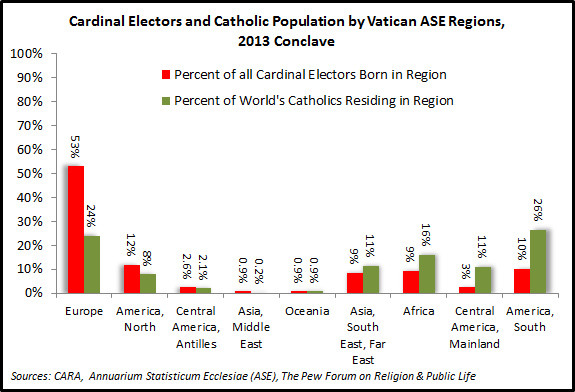
Europeans are overrepresented in the College of Cardinals, the group of elite bishops who choose the pope. As long as Europeans have numbers, it's probably safe to assume that a Southern pope, and thus a pope of color, is unlikely.

Setting that aside, what would be the consequences of a Southern pope? First, since popes tend to appoint from within their social networks, we might expect that a Southern pope would appointment of more Southern cardinals. This could have long-term implications for the Church. Second, a Southern pope and/or pope of color, while symbolically powerful, would not likely bring substantive change to the Church. Several of the African cardinals are hyperconservative, and the Latin cardinals are only slightly more moderate so chances are that the trajectory set by B16 would be continued.

Gibson does point to an interesting cultural disadvantage to non-European contenders: language. Most of the European cardinals are Italian and are privileged to speak Italian in and around Rome. I'm not exactly sure if this is a terribly large factor.

One thing that this succession is reminding us all of, though, is that the history of power in Roman Catholicism is very much about geography. It starts as a pissing match between the See of Rome and the Eastern patriarchs. Today, it continues as a growing laity in the South controlled by a group of elites in the North.

15 February 2013

Friday Music: "White Riot" - The Clash

I give you The Clash's "White Riot":


This is a rather complex one (and probably highly problematic), which I think makes it all the more ripe for sociological discussion. You've got social movements, racism, education, incarceration, class, deviance, and host of other things going on here. It could also be used more largely to talk about how the framing of public discourses.

10 January 2013

Race, Proportionality, and the Liberal Arts Institution

I'm working with some colleagues and students on research involving mission differentiation. Essentially, state university systems need to have their campuses offer different types of education. California was the first state to really do this in a serious manner. Here in Georgia, there was a similar push a few decades ago. Part of that push resulted in Georgia College (GC), where I work, becoming the state's sole designated public liberal arts institution. This meant (in theory if not practice) that GC could cap growth to protect the traditional liberal arts experience, including smaller class sizes and smaller student-to-teacher ratios (again, in theory if not practice). Our research looks at changes in student diversity related to mission shift.

In conversations about our research, something dawned on me: smaller class sizes are bound to compound the experience of race for students apart from campus diversity. Think about it this way. Large classes mean that diversity is more obvious. 13 black students in a 100-person classroom would be proportional and noticeable. Small classes, however, like those in liberal arts institutions, hide that diversity. 1 black student in a 10-person classroom, while still proportional, feels a lot different. As a student of color in our program put it, looking around a classroom and noting "I'm the only one," is a world away from "Oh, there's another one." Our human brains process absolute numbers better than statistical proportionality. (Just ask the students in my statistics class!)

What does all this mean? Despite efforts to make our campuses demographically representative of the larger population, the experience for minority students could still be marginalizing if classroom sizes (i.e. samples) are intentionally limited. This is not to argue that the answer is larger class sizes, only that discussions of campus diversity and minority recruitment and retention need to bring other considerations to the fore at smaller/liberal arts colleges.

26 November 2012

Jesus and Race in the U.S.


Over at Fresh Air, historian Edward Blum talkes about he and Paul Harvey's book, The Color of Christ: The Son of God and the Saga of Race in America. I have yet to read the book, but it seems to have a lot of sociology going on. Specifically, it's about racialized depictions of Jesus in the U.S.

What I find interesting is that host Terry Gross insists on asking, "No, but what color was he really? and she misses the point, that the color/race/ethnicity of the historic Jesus is entirely beside the point that people have been recasting Jesus to look like them (or sometimes not). Like translations of the Bible, physical artistic representations of Jesus are texts, meaning that they are symbolic transmissions of meaning. Just as people tend to interpret the Bible to fit their beliefs regardless of the authors' original intentions, people tend to paint Jesus to match their sense of who they want him to be irrespective to his historic identity.

03 October 2012

Adjectival or Possessive Use of "Color?"

While the term has shown up occasionally over my last three years of teaching in the Deep South (though, never when I taught previously in the Midwest to my recollection), this semester, several students (8/64) have been non-critically referencing "colored people" in their papers. It's quite off-putting. I explained in my comments in their essays that the term is generally considered offensive and that "people of color" is preferred. Admittedly, it's an odd distinction. Unlike other terms that are preferred over alternatives because they are endonyms (e.g. Native American vs. Indian), there doesn't seem to be an obvious reason to favor "of color" over "colored" aside from convention. It got me thinking about usage. Here are the related ngrams:


"Colored" starts to fall out of favor around 1970 and is replaced with "of color" beginning around 1990. Initially, though, "of color" declined with "colored." It was only later that it gained acceptance and became a replacement. While "of color" solves some problems when trying to reference those who are not white (as if white were the absence of color), it is relatively imprecise. I encourage students to say "black" when they mean black. If they mean "those who are not white," non-white is fine.

26 July 2012

Race, Gender, and Religious Language in the Olympics

While I was watching the U.S. Track and Field Olympic trials a few weeks ago, I was struck by the ubiquitous invocations of God and Jesus. While Jeremy Lin and and Tim Tebow get a lot of attention from the media, they were not representative of the people who seemed to be most likely to make such statements during the trials: black women. Sociology has known for some time that these two groups are independently among the most religious in America. Women tend to be much more religious than men, and blacks tend to be much more religious than those of other racial or ethnic groups. I started wondering if there was some intersectionality going here, though. Are black women even more religious than we might predict just knowing that blacks and women are more religious? Turns out, that seems to be exactly the case, and here is a very timely piece from the Washington Post that lays out the case. My only beef with the article is that the issue gets framed in terms of culture instead of structure. Certainly, hyper-religiosity may be a cultural response to being doubly oppressed; oppression, however, is a structural imposition.

I'm not going to delve into the sociological whys of this here, but blacks are overrepresented among the elite amateurs and professionals in certain sports (e.g. track and basketball), and since the Olympics are still gender segregated, we are given a window into this uniquely religious group. While I don't think that athletes are allowed to give on-track post-race interviews at the Olympics in the same way they are during the trials, I will still be interested to hear the overtly religious language in a more religious and ethnically diverse setting.

29 June 2012

Friday Music: "Run to the Hills" - Iron Maiden

Here is the classic heavy metal song, "Run to the Hills" by Iron Maiden:


Maiden here hint at several concepts that are worthy of discussion in an intro-level sociology course all the way up to an upper-level race and ethnicity seminar. These topics include Manifest Destiny, the historic (and ongoing) treatment of Native Americans, the actions of the pioneers of European ancestry, genocide, and ethnic cleansing. The video is intercut with footage from an old Western silent movie. Note for example early on the actor applying "redface."


Lyrics:
White man came across the sea
He brought us pain and misery
He killed our tribes, he killed our creed
He took our game for his own need
We fought him hard, we fought him well
Out on the plains we gave him hell
But many came, too much for Cree
Oh will we ever be set free

Riding through dustclouds and barren wastes
Galloping hard on the plains
Chasing the redskins back to their holes
Fighting them at their own game
Murder for freedom the stab in the back
Woman and children, a coward's attack
Run to the hills - run for your lives
Soldier blue in the barren wastes
Hunting and killing's a game
Raping the woman and wasting the man
"The only good injins are tame"
Selling them whiskey and taking their gold
Enslaving the young and destroying the old

21 May 2012

Clash of Perspectives

Just a quick thought on the progress in the Trayvon Martin case. It is being reported that Trayvon had marijuana in his system and that both Martin and Zimmerman had obvious signs of being in a violent altercation. The pictures of Zimmerman appear to indicate that he got the better of it from Martin. The news media seem to be implying that this complicates the situation beyond the "unjustified white on black crime" narrative. I don't see it this way. None of the new information changes the basics of the case. A black boy was unduly targeted and ultimately killed by a white man. Let's change the facts to give us some perspective. Imagine a white teenage girl was walking home from a friend's house one night when a white man began following her in his car, then exited his car, and began pursuing her on foot. Now, what if the terrified girl pulled mace or a Tazer from her purse and incapacitates the man? Was her use of violence against what she thought was a rapist not understandable? Trayvon didn't have mace or a Tazer; he had his fists. Zimmerman got that broken nose, black-and-blue eyes, and gash on the back of his head because he was un-empathetic; he could not put himself in the other's shoes. Zimmerman's perspective--and that of the larger society--was that an unidentified young black man in a predominantly white, gated community did not belong. Martin's perspective--one shared with most subjugated peoples--was he was being targeted, potentially violently, because of his identity. It was the clashing of these perspectives that led to a tragic outcome, but only one of these perspectives is justifiable. None of this changes the criminal nature of what Zimmerman did. Ironically, Trayvon was just "standing his ground."