This post is a little less critical than usual, but I'd like to ruminate a bit. I've got to say that I'm quite surprised by (and proud of) the rapid and vociferous response to the so called Religious Freedom Restoration Act in my previously-adopted home state, Indiana. It's also heartening that the backlash seems to have affected similar legislation in Arkansa and my current home state, Georgia. Like much surrounding the public opinions regarding LGBT* issues, the surprising thing is not that attitudes are changing but that they are changing so quickly and, moreover, that the changing beliefs seems to be motivating political behaviors in a day of Facebook likes, Tinder swipes, and Instagram hearts. Given these rapid changes, it will be interesting to see where things head from here--especially if SCotUS rules stupidly.
Showing posts with label homosexuality. Show all posts
Showing posts with label homosexuality. Show all posts
03 April 2015

26 June 2013
A Real Post in Celebration
OK, so yesterday, I thought the sky was falling. While all of the awful things that I listed then are still happening and the overall situation is still dire, we do have reason to celebrate today. SCotUS has forced the federal government to recognize homogamous marriages (which means extending more than a thousand federal benefits to all married couples) and essentially revived legal homogamy in California. Some are arguing that it looks as if the Justices have set the stage for a future decision in which they could require all states to recognize homogamous marriages. I speculate that they felt that doing so in this ruling would have gone "too far, too fast," as Ginsburg recently lamented regarding Roe v. Wade. I disagree that a more sweeping ruling in this case would have been overreaching; however, this was a major step in the right direction.
12 June 2013
LGBT for the ELCA
Correction (7:02 PM): Errantly typed ELCA instead of LCMS below where noted.
--
The Evangelical Lutheran Church in America (ELCA), one of the most confusingly named religious denominations ever, has elected its first openly gay bishop. You can read more about it here and here. I just wanted to add a bit of personal reflection to the conversation. I grew up in the Lutheran Church-Missouri Synod (LCMS), the conservative evangelical prodigal brother to the ELCA. (I'm now an Episcopalian via Catholicism.) As a kid, I heard a lot of bizarre stuff in and around church about homosexuality and the ELCA, independently. The ELCA, I was taught, were a bunch of ineffectual, anything-goes liberals who had lost their spiritual way. Generally, it was agreed that those folks weren't going to heaven. I also witnessed a lot of homophobia. I mean this in the true sense of the word in that people--mostly heterosexual married men--were afraid of gay men being attracted to them. It really was, in my experience, that most folks at my church weren't so much intolerant or hateful as they were irrationally frightened. From those with a "traditional" patriarchal view of masculinity, men aggressively pursued what they wanted without much regard to the subjective desires of those they were pursing. In this way, their homophobic reactions were an extension of their cultural--and religiously rationalized--views of gender. What is tragic to me is how long it took me to hear alternative ideas about religion and sexuality, being enveloped in this particular religious subculture. I was well into high school and college before I truly was able to appreciate the backwardness of what theELCA LCMS was selling. While I am no longer Lutheran, I am quite happy to see the ELCA continue their progress as well as to see that progress garnering media attention.
--
The Evangelical Lutheran Church in America (ELCA), one of the most confusingly named religious denominations ever, has elected its first openly gay bishop. You can read more about it here and here. I just wanted to add a bit of personal reflection to the conversation. I grew up in the Lutheran Church-Missouri Synod (LCMS), the conservative evangelical prodigal brother to the ELCA. (I'm now an Episcopalian via Catholicism.) As a kid, I heard a lot of bizarre stuff in and around church about homosexuality and the ELCA, independently. The ELCA, I was taught, were a bunch of ineffectual, anything-goes liberals who had lost their spiritual way. Generally, it was agreed that those folks weren't going to heaven. I also witnessed a lot of homophobia. I mean this in the true sense of the word in that people--mostly heterosexual married men--were afraid of gay men being attracted to them. It really was, in my experience, that most folks at my church weren't so much intolerant or hateful as they were irrationally frightened. From those with a "traditional" patriarchal view of masculinity, men aggressively pursued what they wanted without much regard to the subjective desires of those they were pursing. In this way, their homophobic reactions were an extension of their cultural--and religiously rationalized--views of gender. What is tragic to me is how long it took me to hear alternative ideas about religion and sexuality, being enveloped in this particular religious subculture. I was well into high school and college before I truly was able to appreciate the backwardness of what the
05 April 2013
Friday Music: "Same Love" - Macklemore
I give you Macklemore and Ryan Lewis f/Mary Lambert "Same Love":
This song deals with homogamy, homosexuality, heteronormativity, hegemonic masculinity, and religion among other things.
This song deals with homogamy, homosexuality, heteronormativity, hegemonic masculinity, and religion among other things.
01 April 2013
"Hey, Smoke Up, Johnny!"
Sadly, as a sociologist, I can now thoroughly relate to tobacco researchers of old, evolutionary biologists, and climatologists. A "justice" of the highest court in the land claimed there was scientific dissensus in the face of evidence to the contrary. It reminded me of this video that I use in my Research Methods course every semester:
For all you kids out there reading, learn this lesson well: when your worldview is threatened by evidence, simply lie and say that there is no scientific consensus.
For all you kids out there reading, learn this lesson well: when your worldview is threatened by evidence, simply lie and say that there is no scientific consensus.
26 February 2013
The Ambivalence of a Trojan Gift Horse
One shouldn't look a gift horse in the mouth--unless that gift horse is Trojan. Several big-name Republicans are signing on to an amicus brief in support of homogamous marriage. A clear instance of widespread cognitive dissonance (i.e. I'm being told that homogamy is evil, but I know an increasing number of gay people whose love is obviously good) has caused a lot of anxiety among Republicans. Look closely, though; Republicans aren't simply admitting that they were wrong and that progressives were right. Instead, they are recasting the entirety of the issue as a mass misunderstanding in which gay rights are actually consistent with the conservative political ideology. Instead of their "evolving" stance on homogamy challenging their worldview, they are reframing the issue so that it actually buttresses their worldview. It truly is Bizzaro World. And, I think that it is dangerous. We now seem to live in a world in which people are so ideologically entrenched, be it in their religions, politics, or attitudes, that it is nearly impossible to renegotiate their positions. Some might argue that it doesn't matter how people get there as long as we reach a just ends, but I would counter that the ends aren't actually the same in this case, that "personal liberties" and "social justice" are not only strange bedfellows but diametrically opposed paths with radically divergent ends.
08 February 2013
Friday Music: "Money for Nothing" - Dire Straits (trigger warning)
I give you Dire Straits' (edited version of) "Money for Nothing":
And now, I give you the original, unedited version of the same song (NSfW/trigger warning):
You'll note that the verse that begins around the 1:52 mark of the unedited version includes several uses of the pejorative term "faggot." I don't know the entire history of the song. (Wikipedia has a brief discussion of the controversy.) However, these versions could be A/B'ed in a classroom--with ample warning--to show the changing nature of the acceptability of terminology as well as changing definitions of deviance, both in terms of language and sexual practice/identity. Interestingly, though the F-word declined after its coinage and remained fairly scares mid-century, its use in books seems to have increased since the 1980s.
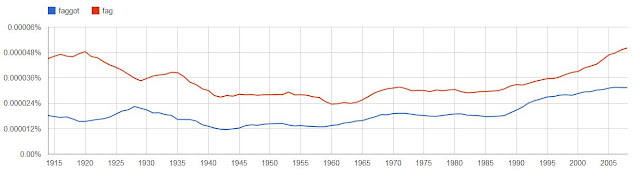
In addition to the anti-gay and homophobic themes, this song can be used to discuss work, class, and conspicuous consumption.
And now, I give you the original, unedited version of the same song (NSfW/trigger warning):
You'll note that the verse that begins around the 1:52 mark of the unedited version includes several uses of the pejorative term "faggot." I don't know the entire history of the song. (Wikipedia has a brief discussion of the controversy.) However, these versions could be A/B'ed in a classroom--with ample warning--to show the changing nature of the acceptability of terminology as well as changing definitions of deviance, both in terms of language and sexual practice/identity. Interestingly, though the F-word declined after its coinage and remained fairly scares mid-century, its use in books seems to have increased since the 1980s.

In addition to the anti-gay and homophobic themes, this song can be used to discuss work, class, and conspicuous consumption.
30 January 2013
Buying the Yellow Brick Road One Paver at a Time
My post yesterday about Chick-fil-A reminded me of this video from the Story of Stuff Project:
Last summer, many of us progressive boycotted Chick-fil-A (here is a related post) after their president and COO, Dan Cathy, spouted off against homogamy and after the extent of the corporation's "charitable" arm's funding of anti-gay causes was widely reported. In reaction, conservatives held a "Chick-fil-A Appreciation Day." These were parallel attempts at economic protest. Both are problematic. "Voting with our dollars" or "consumer activism" only makes sense if we admit that capitalism has radically undermined the democratic process. The way to fight breast cancer is to buy things that companies have painted pink, we are told. The way to save the environment is to buy things that companies box in recycled packaging. They way to fight for workers' rights is to shop anywhere but Walmart. The way to fight for same-sex marriage is to eat anywhere but Chick-fil-A. We are taught to consume our way to utopia. Tony Benn famously said, "...from the wallet to the ballot." Voting with one's dollars is a sign that she has given up on the ballot and that capitalism is vanquishing democracy.
Last summer, many of us progressive boycotted Chick-fil-A (here is a related post) after their president and COO, Dan Cathy, spouted off against homogamy and after the extent of the corporation's "charitable" arm's funding of anti-gay causes was widely reported. In reaction, conservatives held a "Chick-fil-A Appreciation Day." These were parallel attempts at economic protest. Both are problematic. "Voting with our dollars" or "consumer activism" only makes sense if we admit that capitalism has radically undermined the democratic process. The way to fight breast cancer is to buy things that companies have painted pink, we are told. The way to save the environment is to buy things that companies box in recycled packaging. They way to fight for workers' rights is to shop anywhere but Walmart. The way to fight for same-sex marriage is to eat anywhere but Chick-fil-A. We are taught to consume our way to utopia. Tony Benn famously said, "...from the wallet to the ballot." Voting with one's dollars is a sign that she has given up on the ballot and that capitalism is vanquishing democracy.
29 January 2013
Can't We All Just (Not) Get Along?
This blog post is showing up in my inbox and on my FB feed now. It's from Shane Windmeyer, the leader of Campus Pride, an LGBT advocacy group, on his burgeoning relationship with Chick-fil-A's president and COO, Dan Cathy. One of my FB friends wrote that she was "ambivalent" to the piece, which I think accurately describes my feelings as well. One the
one hand, I applaud two human beings authentically reaching out to each
other in an attempt at understanding and respect. On the other hand, I
find it problematic when such engagement is misconstrued as ends
instead of as means. The general narrative seems to be that people are
all essentially well-meaning, our differences are often intractable, so
the best we can do is to hold hands and agree to disagree. The problem is
that only one side's views infringe on the rights and personhood of the
others'. The underlying assumption is
that there are two perspectives, that both are legitimate and valid, and
compromise is sufficient. Granted, it is great that Chick-fil-A's "charitable" arm is no longer
giving to anti-gay causes, but there are still those pesky cultural
consequences spread under the guise of religious belief.
--
UPDATE (1/30/2013): Turns out the rumors of an end to the funding of anti-gay causes were greatly exaggerated.
--
UPDATE (1/30/2013): Turns out the rumors of an end to the funding of anti-gay causes were greatly exaggerated.
25 January 2013
Friday Music: "M. Shepard" - Thursday
I give you Thursday's "M. Shepard":
This is a live version of a song written about the murder of Matthew Shepard. (There are clips on YouTube with better audio, but I like the speech with which singer Geoff Rickly prefaces the song.) The song deals with the difficulty of self-acceptance, hate, love, compassion, and understanding as well as homosexuality, homophobia, identity, and violence.
This is a live version of a song written about the murder of Matthew Shepard. (There are clips on YouTube with better audio, but I like the speech with which singer Geoff Rickly prefaces the song.) The song deals with the difficulty of self-acceptance, hate, love, compassion, and understanding as well as homosexuality, homophobia, identity, and violence.
20 September 2012
When Protests Succeed
Following the widespread outrage of many progressives over the "charitable" giving practices of Chick-fil-A and the audacious statements of Dan Cathy, it's president and COO, the company has promised to direct its nonprofit wing, WinShape, to halt all donations to anti-gay organizations and has issued a corporate memo encouraging all employees and owners to "treat every person with honor, dignity and respect—regardless of their beliefs, race, creed, sexual orientation or gender." While they stop short of enacting actual anti-discriminatory policy (though, as far as I know, discrimination had never been an endemic problem), it certainly amounts to a symbolic step in the right direction. However, I've seen several people on Facebook asking "Does this mean I can start eating at Chick-fil-A again?" It's an important question.
To put this into context, let's look back to another social justice campaign, the Civil Rights Movement of the 1950s and '60's. When buses refused to change their policies about priority seating for white passengers, black customers boycotted the buses, choosing instead to walk whenever they could and to organize carpooling when they couldn't. The protests were ultimately successful, and the bus companies were forced by the courts(albeit grudgingly and primarily for economic and not moral reasons) to change their racist policies. When this happened, the black protesters started riding the buses again. Imagine if they hadn't, though. What if Southern blacks had decided that the reversal of the policy wasn't enough? What if the movement demanded more of their oppressors? What if animosities had been allowed to overshadow the victory? I think this would have been detrimental in a couple ways. First, it would have eroded the sympathy that the Civil Rights Movement had been fostering among non-black wouldbe allies, thus weakening the long-term chances of success of the movement. By not being goal-oriented, the movement would have risked playing into many's suspicions that it was about agitation per se and not about results. Second, the Civil Rights Movement had always been about social equality, about desegregation, and about reunification. By refusing to return to the buses, the Civil Rights Movement would have not only been guilty of baiting-and-switching in the immediate goals of the boycott but also would have been abandoning the overarching goals of the movement itself. Why would things be any different for the Gay Rights Movement?
We should not overlook the fact that the changes at Chick-fil-A are a victory for the protesters. This battle is won. Admittedly, circulating memos and making pronouncements is one thing; actions are another. Observers should most definitely keep a close eye on on the corporate culture at Chick-fil-A and the giving practices at WinShape. In the meantime, I'm going to treat myself to a Spicy Chicken Sandwich--while doing my best not to look smug while eating it.
--
UPDATED (1:47 PM)
UPDATED (9/24/2012): Looks like Cathy didn't get the memo.
To put this into context, let's look back to another social justice campaign, the Civil Rights Movement of the 1950s and '60's. When buses refused to change their policies about priority seating for white passengers, black customers boycotted the buses, choosing instead to walk whenever they could and to organize carpooling when they couldn't. The protests were ultimately successful, and the bus companies were forced by the courts
We should not overlook the fact that the changes at Chick-fil-A are a victory for the protesters. This battle is won. Admittedly, circulating memos and making pronouncements is one thing; actions are another. Observers should most definitely keep a close eye on on the corporate culture at Chick-fil-A and the giving practices at WinShape. In the meantime, I'm going to treat myself to a Spicy Chicken Sandwich--while doing my best not to look smug while eating it.
--
UPDATED (1:47 PM)
UPDATED (9/24/2012): Looks like Cathy didn't get the memo.
10 August 2012
Valor, Gallantry, and Heroism by Sexuality and Gender
Just a quick thought here. Several of the victims of the shooting in the Aurora theater died while shielding their female partners. While the immediate emotion of the incident is probably pretty raw, it nonetheless offers a great demonstration of some sociology. Here are a few questions that might facilitate a discussion in class:
- What if a woman had shielded a man?
- What if one gay man had shielded another man?
- What if a lesbian had shielded another woman?
- Can you imagine any other pairings of shielder/shieldee that would run contrary to our role expectations? [e.g child shielding adult]
- What can we learn from this about gender? sexuality? heroism?
03 May 2012
Bullshit and the Bible
Gay-rights blogger Dan Savage told a conference for the Journalism Education Association and the National Scholastic Press Association that "we can learn to ignore the bullshit in the Bible about gay people." It caused quite a stir. It seems to me that there are three competing claims:
- The Bible is unclear, inconsistent, or silent on what we today call homosexuality.
- The Bible condemns homosexuality; thus, we must call homosexuals to repent and reorient.
- The Bible condemns homosexuality; however, we can overlook those parts of the texts.
01 May 2012
Unnatural Definitions
A couple months ago, Kirk Cameron caused a bit of an uproar when, in response to Piers Morgan asking him if he thought homosexuality was a sin, he said, "I think that it's unnatural." Predictably, the internet lit up with responses. One blogger wrote this parenthetical:
(You're also wrong about homosexuality being unnatural.... I mean, you're aware television is "unnatural," right? So are pants. So are eyeglasses, cell phones, indoor plumbing, the Growing Pains complete second season on DVD, and just about any weapon more complicated than a rock. The rule I would like to apply moving forward is that anyone using "unnatural" as an intrinsic reason for something being bad or wrong must commit to a life of Rousseauean simplicity in a location untrammeled by the unnatural accoutrements of human civilization. I recommend the forests of Papua New Guinea or any place in Siberia, so long as it is above the Arctic Circle [emphasis in original].)
Here is a similar, and intentionally ironic, argument from a Tumblr pic that is making its way around Facebook:
Being gay is not natural. Real Americans always reject unnatural things like eyeglasses, polyester, and air conditioning [emphasis in original].
When conservative Christians use the term "unnatural," they do so with a specific intent and with a traditional understanding of its definition, and when progressives--Christian or otherwise--respond, they often misconstrue "unnatural" to mean "not occurring in the natural world" or "being human-made." If progressives truly hope to have a dialogue with conservative Christians in which to persuade or refute them, we need to have a shared sense of
meaning.
So, what do conservative Christians mean by "unnatural?" We need to go back to Paul's letter to the Romans (1:26-27):
For this reason God gave them up to degrading passions. Their women exchanged natural [κατα φυσιν] intercourse for unnatural [παρα φυσιν], and in the same way also the men, giving up natural [κατα φυσιν] intercourse with women, were consumed with passion for one another. Men committed shameless acts with men and received in their own persons the due penalty for their error.
While there has been debate about proper translations of παρα φυσιν and κατα φυσιν [1][3], it seems reasonable that "contrary to nature" and "natural" are respectively appropriate translations of these phrases. The larger ancient discussion about "nature" was more a debate about cultural appropriateness as after-the-fact evidence of divine intention as opposed to a universalistic claim to natural law. Paul’s παρα φυσιν argument is intended to "maintain a gender stratified social order" of women as subordinate to men.[2] Paul’s larger argument, then, in this context is about the Western pro-family ideology first championed by Augustus out of political expediency.
When conservative Christians say "unnatural," they mean this in the biblical and historical tradition of "contrary to God's intended state of things," not "not found in the natural world." The distinction matters.
All that said, I want to stress that I think Cameron and others who claim that homosexuality is "unnatural," by either reckoning, are wrong. This, however, is beside my point in this post.
--
[1] Boswell, J. 1980. Christianity, Social Tolerance and Homosexuality. Chicago: University of Chicago.
[2] Brooten, B. 1996. Love Between Women. Chicago: University of Chicago Press.
[3] Hays, R.B. 1986. "Relations Natural and Unnatural: a response to John Boswell’s exegesis of Romans 1." Journal of Religious Ethics 14:184-215.
12 April 2012
Conflicting Depictions of Gay TV Characters
I've been following the NBC sitcom Happy Endings this season. The series is ahead of the curve in many ways, such as by including an interracial married couple and the character Max Blum, played by Adam Pally. One of the six central figures on the show, Max is gay but runs against stereotype. He is pudgy, enjoys playing video games and watching sports, dresses poorly, and is generally a slob. Here is a clip of Max in action:
Max's romantic mishaps are often part of the episode plots, but his sexuality is otherwise not central or emphasized in the way that homosexual characters' identities have been in other series (cf. Will & Grace). Max is endearing and is a major factor in my enjoyment of the show.
Enter Derrick.
Derrick, played by Stephen Guarino, is stereotypically flamboyant, and his eccentricities are played for comic effect. Case in point:
It's deeply upsetting that a single series could give us progress in a character like Max and then snatch it back with a character like Derrick.
12 March 2012
PRRI Findings on Attitudes about Same-sex Marriage
Exciting new research from the Public Religion Research Institute! "Generations at Odds: The Millennial Generation and the Future of Gay and Lesbian Rights" has a lot of meat in it. Here is a link to their summary. Below is some stuff that I find particularly exciting.
Average public support is up:

Majorities in all traditions, except Black Protestants and white Evangelicals, favor same-sex marriage:

This largely matches people's understanding of the theological judgements of homosexual sex by tradition:

Not surprisingly, those who attend religious services more often are less likely to support same-sex marriage; however, Catholics who attend infrequently are more supportive than Catholics who attend seldom or never. I wonder what's going on there.

Encouragingly, a growing chunk of folks would be unfazed if their church started blessing homogamous couples:

Subscribe to:
Posts (Atom)